
How We Rank
What goes into the Prep Hoops rankings? How can you get on to our radar? Why did someone move down?
Check out the sections below to learn about how our rankings are determined.
Exposure Tips
Ways to improve your chances of being evaluated, move up, and use the rankings as a tool.
Purpose & Standards
Our rankings exist to bring exposure to the maximum number of athletes pursuing the recruiting process, with a chance to play at the next level.
Our Scouts are tasked with filtering out players who haven’t shown traits that translate to the next level, but we don’t pride ourselves on exclusivity. We’re trained to recognize the potential and value that each player brings to the game. In fact, extending the list every update is a requirement for all Scouts.
We’re proud that our rankings include more players relative to competing national scouting sites.
| Name | Players Ranked |
|---|---|
| Nation Prep | 9,142 |
| ESPN | 885 |
| 247 Sports | 738 |
| On3 | 660 |
Our Scouts pride themselves on how well they know the game. We put a lot of time and energy into putting players in order and are as diligent as we can be to get it right.
The most important guideline for our Scouts is that the rankings are a projection of someone’s future collegiate potential, not a reflection of their current ability.
In the same way that the Heisman trophy winner doesn’t get picked first in the NFL Draft every year, the high school player of the year also isn’t always our #1 ranked player. We have plenty of room in our articles to recognize high school accolades and statistical achievements. The rankings, however, should give readers an idea of how players will perform at the college level.
The standards above and in the links below outline the expectations. These expectations are shared with our scouts and championed by the editors. We will continue to do the best we can and work to improve areas where our credibility has been questioned.
Finally, we owe it to our audience to explain what changed in each update, why players move down, and what we’re looking for in prospects. Please tune into your site post-update to see who the New Additions and Stock Risers are in each update.

Our Criteria
On one hand, it’s quite simple:
Athleticism
Size
Skills required at your position
IQ and understanding of the game
Effort level
Toughness
Intangibles such as body language
On the other hand, all of our scouts place slightly different levels of value on each of those categories.
Most importantly, though, players are ranked on their potential as college prospects. The rankings are not based on performance in high school. That’s consistent across every Prep Hoops website.
If a player is more athletic, taller, or larger, that will compensate for current skill deficiencies. There’s the old adage that you cannot teach size and skill. If you go down the different levels of college athletics, the difference is very rarely in skill level. The biggest gaps are in size, explosiveness, and athleticism.
This distinction between high school production versus collegiate potential is a huge distinction and where we see parents and players get hung up the most. There are countless All-State players who end up as Division III recruits, while late-bloomers who barely play until their senior year become consensus Division I prospects.
College recruiters and Prep Hoops scouts are looking for plays and flashes of athleticism that translate to the college game. Sometimes a high school player may only make a few plays in a game that wind up in the stat sheet. But if there are one or two displays of extraordinary athletic burst during the contest, there’s a difference in the way those are evaluated that is reflected in our rankings.
Some scouts may value high school production and stats more than others, and that’s absolutely allowed. It is a skill to compete and produce every night. At the same time, players need to be able to compete athletically and match up in size against your competition. The bar for athleticism and size continues to rise with the collegiate level. In order to be productive in college, you’ll need the requisite athleticism and size, whereas skills can be taught. So those differences, again, are reflected in our rankings.
Why did my ranking change?
We would never publish an article dedicated to the specific players who moved down in a rankings update. Our site is here to celebrate athletes’ achievements and skills. But the reality is that many players do drop on the list every update.
The question will inevitably arise, as it always does when we update the rankings: “Why did he get moved down?”
It’s a fair question, but in reality almost nobody is moved down the list on purpose. Rather, they’re bumped by newcomers who’ve made a big splash since the last rankings updates and kids who have raised their stock. We shouldn’t say it never happens, but players are only moved down in the rankings in the case of some extraordinary negative occurrence. For example, a player who leaves their high school team in the middle of the season for no apparent reason. A player who gets in some kind of serious trouble on or off the court – a fight on the floor or an extended suspension, for example.
“Wait a minute,” you might say. “My son went from 75th to 85th. They were definitely moved down.” Actually, that’s not what took place. What’s happened is that he has been passed in the rankings by others who have done more.
How it works
Let’s use a hypothetical example. Say a player – let’s call them Sam Thomas – is currently ranked #75 in their class. Sam had a good high school season so far but hasn’t exceeded expectations, hasn’t cracked the starting lineup, hasn’t grown from 5’5”. None of this is unusual for a high-schooler. Given that nothing has really changed, shouldn’t Sam still be ranked #75? Not according to the math. Why? Because there are always newcomers who work their way into the rankings. And there are always kids who have exceeded expectations, who have cracked the starting lineup, who have grown two or three more inches and added 10 pounds.
If 25 new kids are added, and three of them are ranked higher than Sam, that now puts Sam at #78. If three kids have raised their stock enough to move into the Top 75, that means Sam is now at #81. In other words, by maintaining their current level of performance, Sam got passed by six other players.
Let’s review the math. First we’ll add the three newcomers with their rankings:
- #55 – Newbie 1
- #65 – Newbie 2
- #72 – Newbie 3
After these insertions, all in the Top 75, Sam’s ranking changes from #75 to #78. Now we factor in the three hypothetical players who raised their stock.
- Jordan Timmons goes from #85 to #55
- Jesse Smith moves up from #78 to #68
- Logan Jones improves from #80 to #70
What does this do to Sam Thomas’ ranking? Unfortunately, Sam moves from #78 to #81. The numbers don’t lie.
Let’s face it: Athletes separate themselves all the time in every respect. For example, some kids grow. Some kids don’t. While being 5’5” isn’t a liability in the 8th grade it becomes more problematic by a player’s sophomore year. There’s nothing you can do about it, of course, but it is a recruiting reality that size matters. A ton.
A large number of kids tend to hit their stride in the 10th and 11th grade. Those whose growth spurt came a year ago frequently find their coordination. Kids who have invested in their skill development start to show the fruits of that labor against stronger varsity opponents. Others stagnate. Plateau. Level off. Whichever term you want to use, we often see early bloomers tail off and later bloomers take off.
So if a player on your team, or your son sees their ranking go from #88 to #95, this is why it happened.
Exposure Tips
Tips to improve your chances of being seen, and therefore ranked, by Prep Hoops:
- Compete in club and offseason events. In order to rank you, we not only need to know of you, we also need to see you play. Playing as often as possible increases your chances.
- Disclaimer: Playing in Prep Hoops events does not guarantee you will be ranked, nor does it give you preferred placement higher in the list. Our scouts, however, are guaranteed to attend those events so it does increase your chances of being recognized, organically. To sum it up, attending Prep Hoops events won’t get a player into the rankings but it will provide them with the best opportunities to showcase their skills in front of the right people at the right time.
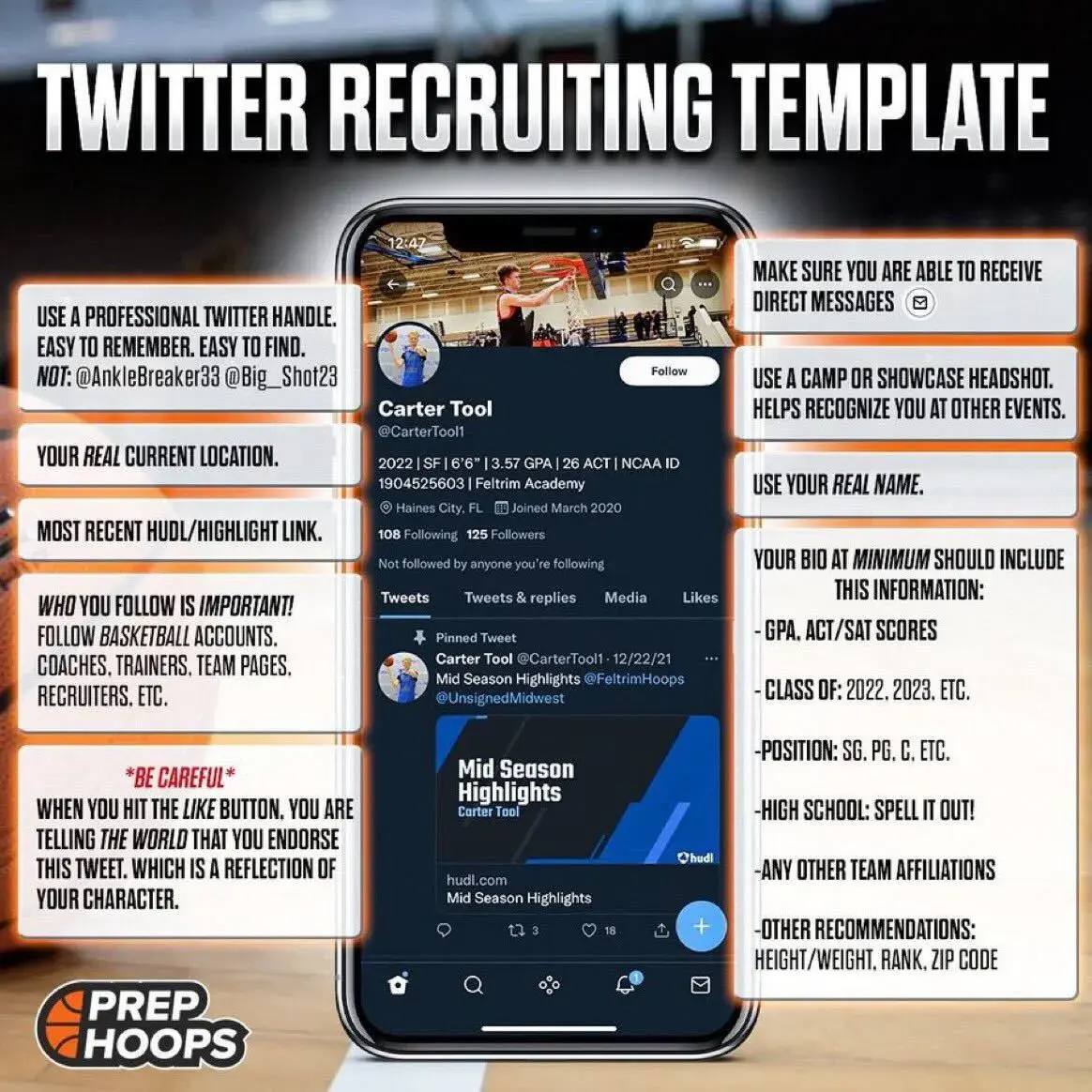
- Send information to our scouts. They’re also on social media! You don’t need to ping them every month — in fact we advise against being overly communicative — but keep them up to date with your highlights and schedule by sending it to them via direct message.
- Excel on social media. Use your real name. Put your high school, club team, position, accurate size, and GPA in your bio. Link to your highlight videos. Pin your schedule.
I am already ranked or I’ve already been evaluated by your scouts. How can I improve my standing:
- Ultimately you are the common denominator in your recruitment. If you’re really a player, if you’re sharp when the pressure is on, if you’re putting in the work away from the public eye, your standing will improve and you will be recruited. Irrespective of our rankings, you will get recruited if you’re a college-level talent. Take care of what you can control and all of the rest of these tips are extra additions to the most important piece: your work ethic and ability to play.
How to use the rankings as a tool:
- Claim or create a profile on Prospect Index.This gives every prospect the ability to control their player profile. From fixing the spelling of their name, to the school they attend, to updating their college offers – prospects & their families will be able to do it all. Additionally, the Prospect Index will allow players & their families to provide accurate contact information that will be visible to college coaches across the country, making it easier for them to reach out directly if they are interested.
- Share a screen-shot of your player profile on social media! While rankings are not the be all, end all, they are a great database for college coaches and scouts trying to navigate the massive scope of the recruiting landscape. Signaling your ranking online to college scouts could help them understand that you should be on their recruiting board!
- When reaching out to college coaches, link your Player Profile in your email. We have plenty of college coaches who subscribe and are familiar with navigating our website. Feel free to link articles, social media, and videos our scouts have on you in your communication.
Frequently Asked Questions
Don’t see an answer to your question?